
WHY RECOVERY IS THE MISSING LINK IN MOST TRAINING PLANS
Many people associate progress with doing more - more workouts, more intensity, more discipline, more structure. Effort is often seen as the primary driver of improvement.
But the body doesn’t get stronger during training. It adapts and rebuilds during recovery.
Recovery is where tissues repair, the nervous system resets, inflammation settles, and movement quality improves. Without adequate recovery, performance can plateau, tension accumulates, and the body begins to operate in a constant state of stress rather than adaptation.
At Stretch Bar in Perth, recovery is viewed as an essential part of maintaining physical wellbeing - not something reserved only for injury or burnout, but a proactive approach to supporting how the body moves and feels long-term.
WHAT RECOVERY REALLY MEANS (BEYOND SIMPLY RESTING)
Recovery is often misunderstood as simply taking time off. While rest can be helpful, effective recovery involves supporting multiple systems in the body that influence movement, flexibility, and overall physical resilience.
During physical activity, muscles experience small amounts of stress and microscopic tissue change. This is a natural part of adaptation, but the body needs circulation, mobility, and nervous system balance to repair efficiently.
The nervous system also plays a significant role in recovery. Stress, long periods sitting, busy schedules, poor sleep, and demanding training loads can all keep the body in a heightened state. When this happens, muscles remain tense, breathing patterns become restricted, and movement quality can decline.
Fascia - the connective tissue surrounding muscles and joints - responds to movement variety and manual input. Without supportive recovery, tissues can become restricted, contributing to stiffness or reduced flexibility.
Circulation and lymphatic flow help deliver nutrients and remove waste products from tissues. Treatments that support circulation can improve how efficiently the body recovers between periods of activity.
Recovery is not passive - it can be supported intentionally.
WHY TRAINING MORE DOESN’T ALWAYS LEAD TO BETTER RESULTS
One of the most common misconceptions is that soreness always signals progress. While some muscle soreness can be part of adaptation, persistent tightness, fatigue, or stiffness often indicate that recovery capacity is being exceeded.
When the body doesn’t have sufficient opportunity to recover:
Movement quality can decline
Fatigue accumulates
Small aches can become persistent issues
Sleep quality may be affected
Motivation can decrease
Performance may plateau
This is not a lack of discipline - it is often a mismatch between physical demand and recovery support.
Training creates stimulus. Recovery allows adaptation.
Both are necessary for long-term progress.
THE NERVOUS SYSTEM’S ROLE IN RECOVERY
The nervous system influences how relaxed or tense muscles remain, how efficiently the body coordinates movement, and how well sleep and digestion function.
When the body remains in a constant “on” state - often influenced by work demands, screen exposure, deadlines, and physical strain - recovery can feel slower and movement can feel more restricted.
Treatments that support nervous system regulation can help the body shift into a more balanced state, allowing tissues to release tension more easily.
Approaches that may support this include:
gentle manual therapy
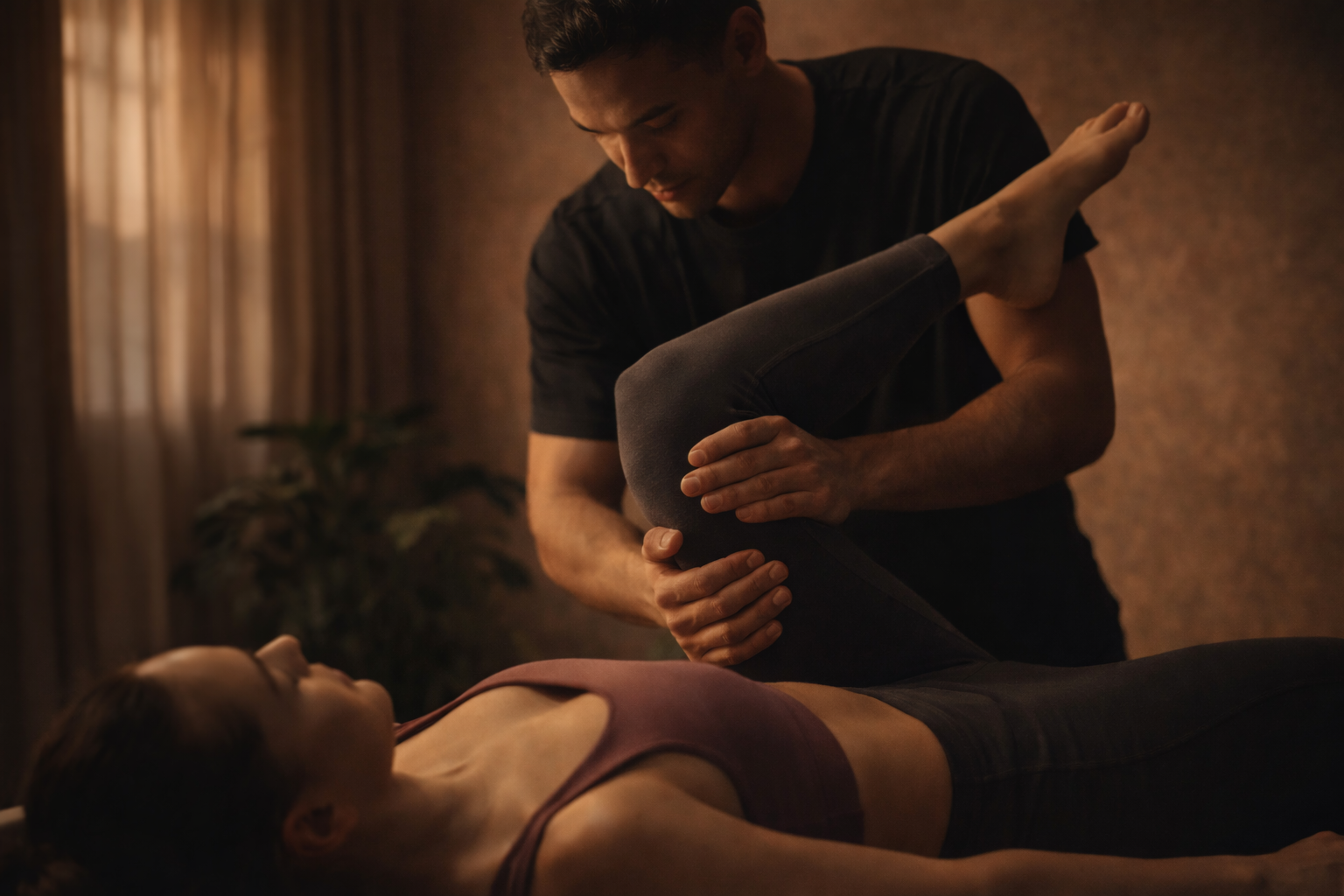
assisted stretching
heat exposure
calm environments
consistent recovery routines
This is why environment and pacing play an important role in effective recovery.
WHAT INTENTIONAL RECOVERY CAN LOOK LIKE
Recovery does not need to feel complicated or time consuming. Small, consistent interventions can support how the body adapts to daily physical and mental demands.
Examples include:
using heat therapy to support muscle relaxation
incorporating assisted stretching to improve mobility safel
using manual therapy to address areas of tension
introducing contrast therapy to encourage circulation
allowing time for the nervous system to downshift
creating simple recovery habits within a weekly routine
The goal is not perfection, but consistency.
Explore treatments that support recovery:
• Stretch Therapy & Assisted Stretching
• Sports Massage & Deep Tissue Recovery
• Inrared Sauna & Ice Baths
• Compression Therapy
RECOVERY SUPPORTS PERFORMANCE, NOT JUST RELAXATION
Recovery is often associated with relaxation, but it also plays an important role in supporting movement efficiency and physical resilience.
When the body is supported to recover consistently:
Range of motion can improve
Movement patterns may feel more fluid
Muscles may respond more efficiently to training
Energy levels can feel more stable
Physical tension can become easier to manage
Risk of recurring restriction may reduce
Recovery allows the body to adapt more effectively to physical demand.
RECOVERY IS NOT A LUXURY - IT’S PART OF A SUSTAINABLE ROUTINE
Recovery has often been positioned as something occasional, but modern lifestyles place significant demands on the body.
Long hours sitting, repetitive movement patterns, cognitive stress, limited sleep, and busy schedules all contribute to physical tension.
Learning how to support recovery consistently can improve how the body responds to these demands over time.
At Stretch Bar, recovery is approached as a practical and supportive process that helps maintain mobility, reduce muscular restriction, and support long-term physical wellbeing.
Because progress is not built through effort alone - it is supported through consistent recovery.
Recover stronger.
